'Our Family Hobby'

We began collecting Kenyan Sand Boas initially as a way to conquer our fear of snakes. Then we discovered that the whole family enjoyed the care and handling of Kenyans. It has exploded from there. We like this particular breed of snakes because we have a younger family. These East African Sand Boas are smaller, slower than the other breeds of snakes available, easy to care for and relatively new to the US pet trade with new morphs being introduced every year.


CLICK ON ANY PICTURE TO SEE IT FULL SIZE


VISIT OUR WEBSITE AT http://www.sandboamorphs.com/


Sunday, February 27, 2011

Facility Pictures


 Here's where all the magic happens! We use exclusively Reptile Basics racks. Whether they were built specifically for sand boas or geckos is up for debate. But what is clear is theat they are loved by not only small enthusiasts such as myself, but the big boys as Ben Siegel and Ron Tremper. In the image above to the left are our 4 Iris MCB-S breeder racks from Reptile Basics. We elected to go with belly heat since we keep our female breeders in these racks and love the medium hides with the midget water dishes. Throw some aspen or sani-chips in and you've got 32 perfect big momma dens!
Above, on the right, are the Iterdesign 68 tub juvenile racks from Reptile Basics. They are amazing, super compact and easy to clean! We can get 68 babies in one rack and due to there length we can grow out the Kenyans out to about 50 grams (approx. one year). I'm pretty sure that Reptile Basics also offers a 34 tub rack if you don't need all that space. We have plans of adding one more Interdesign 68 tub around May or June to handle our projected litters.


The three racks directly ahead are our Iris 16 tub shoe box racks. They are perfect for sub adult females and grown males. We always have a seperate tub set up for each of our breeding males. It makes it so much easier to pull them straight out during feeding time.  The majority of the year the males stay in their shoebox tub with plenty of room. I've seen on-line people have males 300 grams (+ ) in them but we keep our breeders around 125 grams and don't fatten them up beyond that. 


Thank you Travis Rose.....we got this freedom mouse breeder rack from Travis and had a great time driving up to Kentucky to pick it up! Automatic water and big hoppers for feed means we don't touch this thing but once a week to fill up the 'gravitation' bucket (aka 10 gallon bucket) and the food wells. Clean the tubs once a week and you can run 75 adult mice females of your own.

Stripes begat other Stripes

The original normal stripe was produced by crossing a Rufescen and a Normal Kenyan Sand Boa.

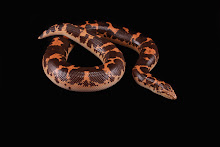
The above picture is a Rufescen Kenyan Sand Boa. By breeding a rufescen to a Normal Kenyan Sand Boa you can expect 1/2 the litter to be Tigerish/Normals (visually they will look like normals but typically they will have more black saddling looking more like tiger stripes and they tend to hold their color as they age much like crossing a dodoma kenyan sand boa to another normal). The other 1/2 of the litter will be visual normal looking stripes. Scott Miller has spent many years breeding stripes and he believes the tighter cleaner stripes bred to whatever morph you decide tends to create tighter cleaner stripes. Keep an eye out this summer, the best looking stripes will be priced quite a bit more than the lesser looking stripes. The below picture is of a 2008 High Orange Flame who we hope to breed next year, by sending a Rufescen Kenyan Sand Boa to her you'd get 1/2 a litter of High Orange Tigers and 1/2 a litter of High Orange Stripes, most likely. Surprisingly, some rufescens throw some really great colored babies.

You don't just have to breed a rufescen to a particular morph to get a litter of stripes, you can simply breed a stripe to any morph (albino, anery, snow) and expect a litter 1/2 of tigers and 1/2 of stripes. Although, we have seen that the stripes bred to other morphs don't produce as many tiger looking Kenyans, probably due to the fact that they don't have as much 'rufescen' blood (stripes start out 1/2 rufescen and each generation carries 1/2 less of the rufescen genetics).

Breeding a Rufescen or Stripe to an Albino like below would result in 1/2 a litter of tigers het albino and 1/2 a litter of Visually Normal Stripes het albino.

Breeding a Rufescen to a Snow like below will result in 1/2 a litter of Normals double het for Snow (albino/anery) and 1/2 a litter of Visually Normal Stripes double het for Snow (Albino/Anery).

Breeding a Rufescen or Stripe to an Anerythristic (Anery) like below would result in 1/2 a litter of tigers het anery and 1/2 a litter of Visually Normal Stripes het anery.


This picture is courtesy of Scott Miller, it was recently pictured in Reptiles Magazine as a new morph he created. This is an Anery Stripe and it was produced by breeding an Rufescen to an Anery which resulted in a visually normal stripe het for anery. Then that Visual Normal Stripe het Anery was bred to an Anery.


Which brings us to the below pairing. The visual normal stripe is het for anerythristic (anery/black and whites). The large female is a snow carrying the recessive genes for albino and anery (lacks the black saddle color and the orange coloring). By breeding a visual normal stripe het anery to this snow I can expect 4 different morphs in the resulting litter. Most importantly, I should get Anery Stripes het for Albino and visually Normal Stripes het for anery and albino. I will also get normals het snow (anery/albino) and anerys het snow (in this case albino since they are visually carrying the anery gene). SO WHAT SOME OF YOU ARE THINKING? Well by taking either a male visual normal stripe het snow or a visual anery stripe het snow from this litter and breeding it to a snow female next year I will be able to produce Snow Stripes, Albino Stripes and Anery Stripes all in the same litter! To top it off I will also receive normals het snow, albinos het snow and anerys het snow. That's 6 different morphs that can come from just one pairing. WHAT DOES THIS MEAN TO ME? If you want an Albino or Snow Stripe this year I suggest you contact Jeff Holloway or Scott Miller, I will not be producing any this year but if you are looking to produce them yourself and are willing to buy hets, I will have some available. These two were paired together in February and I'm hoping for a litter around July 2011.


I have seen a lot of stripes over the past couple of years and the one above is one of the cleanest I've come across. Actually, I didn't come across him or pick him out, Scott Miller bred him and picked him out for me. In fact, Scott has sent me a total of 5 normal stripe het anerys and all 5 have been phenomenal specimens. Using the old addage of breeding the best to the best and hoping for the best...we're hoping for a great litter of stripes from this pairing! Mark@LHALegal.com

Saturday, February 26, 2011

Available Page Updated

The available page is up to date as of now....

Cool additions, Snow Female, Rufescen Female and Flame Female....

Recent Breeding Pairings

We have an adult breeding pair of nuclears (pictured last) that we purchased a few months ago from Jeff Holloway. My plan was to breed the male to the female and wait for the litter. But he wasn't showing much interest in our nuclear female so we paired him with this normal female. We expect some nice colored babies come June 2011.


Snow female to a Stripe Het Anery Male. This is the second most anticipated pairing of the season for us after our nuclear pairing. By breeding our stripe het anery to a snow female we anticipate creating normal stripes het snow and anery stripes het snow. The significance of those two morphs is that if bred back to a snow you will see a litter of anery stripes, albino stripes and snow stripes. Or if bred to a Kenyan het for snow regardless of morph you'd have the possibillity of getting the same above.


Tiger het Albino Paradox Female and a Snow Paradox Male. This is Braxton's (our son) pairing as he owns all of the paradoxes and hets in our collection. We hope to prove out this tiger female by producing some snow or albino paradoxes (or both). Anticipated birth August 2011.


Reduced Patterned Anery Female to a Reduced Patterned Anery Male...I can't tell you how many emails I've gotten asking when the next reduced patterned anery's are going to drop...where here is the next pairing we anticipate this litter to drop August 2011. 


Nuclear Breeding Pair....anticipated litter due in July 2011...